experiments
Build Super Mario Web Edition for $0
Test-riding local model prowess
This is an informal local-model capability test: give a local Qwen3.8 27B model one open-ended prompt in LM Studio, turn Wi-Fi off, and see whether it can ship a complete browser game without follow-up instructions.
Create Super Mario game which can be played in a web-browser. Make suitable assumptions.
The result took roughly four hours of unattended local inference and no follow-up prompts. It is a self-contained, Super Mario-style platformer: no dependencies, build step, network requests, or downloaded art assets.
This is not a benchmark or a claim that one model is universally better than another. It is a practical look at what local, offline inference can produce when the task is concrete and the model has room to make sensible assumptions.
Watch the run
The screen recording shows the one-shot prompt in LM Studio and the locally served game being played in a browser.
Play it
Controls: arrow keys or A / D to move; Space, W, Z, or up-arrow
to jump; Shift or X to run; P to pause; R to restart; M to mute.
What the artifact contains
- 1,592 lines across three runtime files: HTML, CSS, and vanilla JavaScript
- Canvas-rendered visuals and synthesized WebAudio effects, with no external assets
- Two levels with movement, variable-height jumping, blocks, power-ups, enemies, shells, pits, pipes, a timer, flagpole finishes, pause, and restart
- A headless Node test harness with 59 passing assertions across gameplay and render states
- Works directly from
file://, so it remains playable with no internet
Why test this locally?
Local and edge models can reduce latency, preserve privacy, and make experimentation possible without metered API calls. This run used a local model in LM Studio after the model was already present on the laptop, so the build itself did not require an internet connection or an inference bill.
The broader point is not that every task should be generated unattended. It is that useful, testable software can increasingly be prototyped on personal hardware, where the marginal cost looks much closer to electricity than a per-request cloud bill.
Tools used
- LM Studio for local, offline inference
- Qwen3.8-27B open-weights model
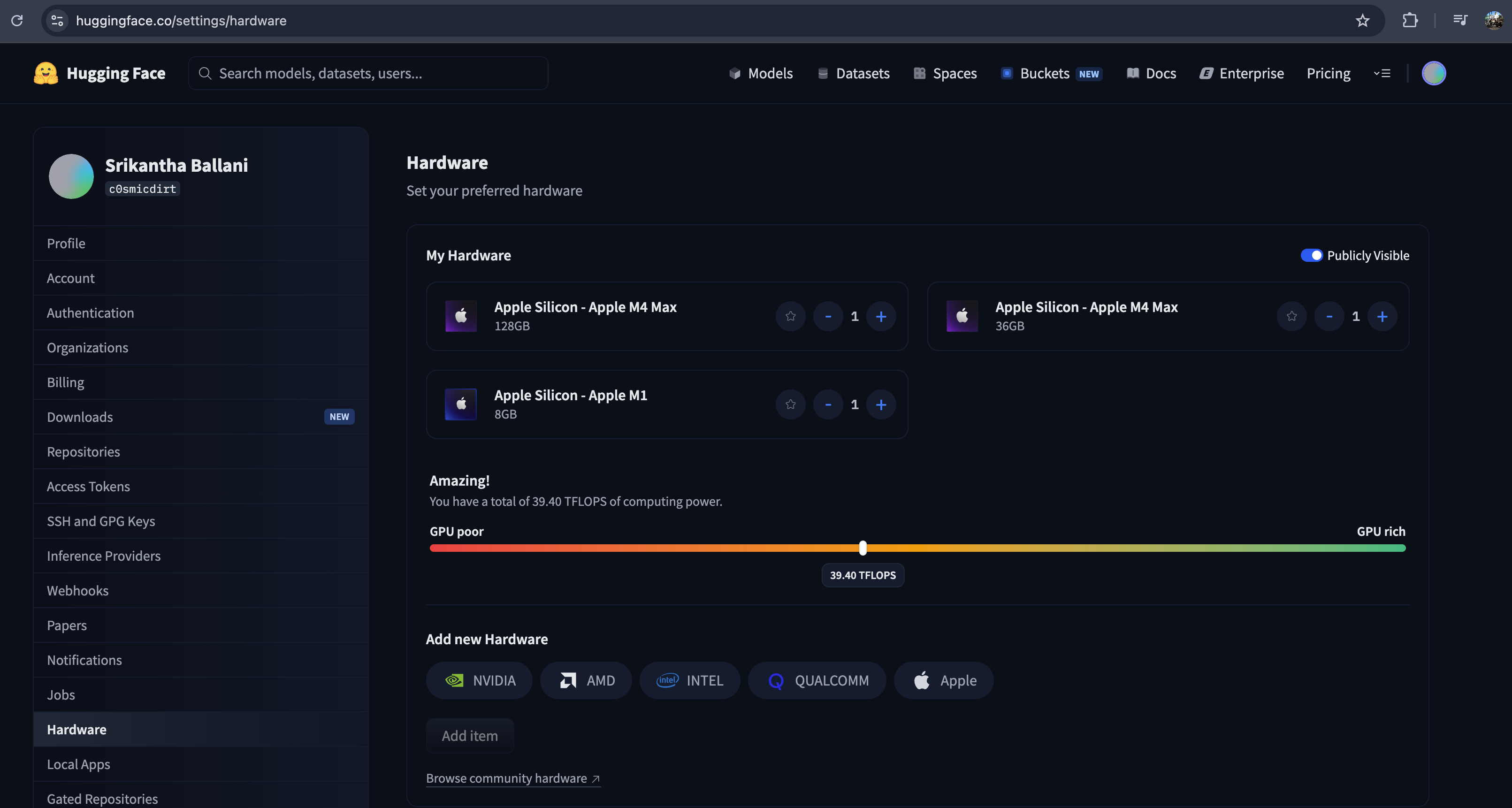
GPU poor, still useful
Hugging Face’s GPU Poor framing fits this run: personal compute is enough to ship a complete prototype when the model is small enough to run locally.